

Web
Next.js
A modern web technology for fast, search-friendly websites, online stores and web applications that load quickly on mobile.
Used for
- Business websites
- Online stores
- Web apps
- Customer portals
Business & enterprise
Practical software for Indian small and medium businesses: ordering, billing and operations tools phased to fit an SMB budget.
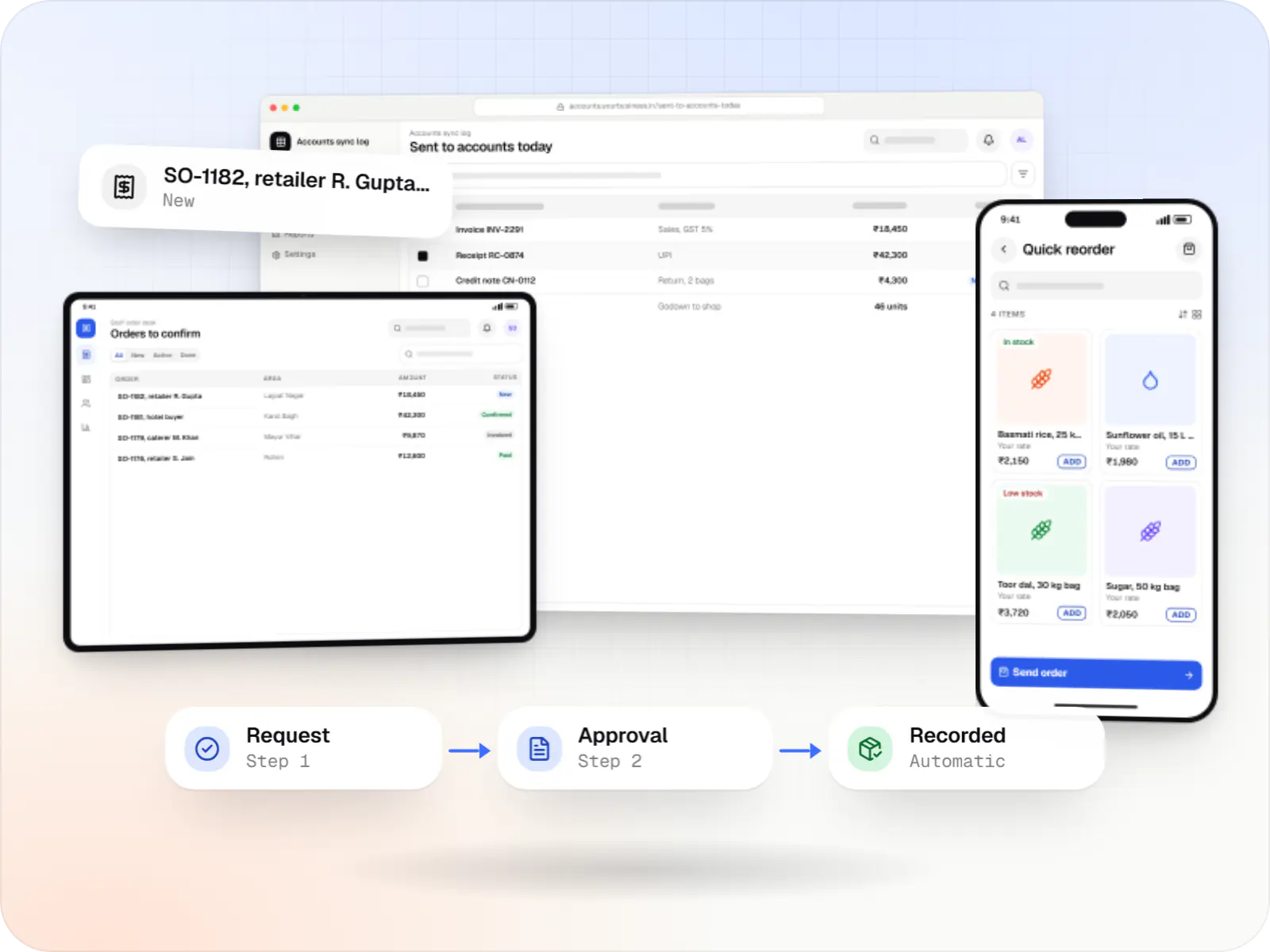
At a glance

SMBs need software that pays back quickly and fits how they already work. We help you decide what to buy off the shelf, what to build custom and how to phase it so each stage is affordable.
Flutter and the related logo are trademarks of Google LLC. We are not endorsed by or affiliated with Google LLC.
How to start
Tell us what you need in your own words. You talk to the developers who would build it and get a written, line-item estimate.
Get a project estimateMost SMBs already use several tools: Tally or Zoho Books for accounts, a billing app, spreadsheets for stock and orders, and WhatsApp for nearly everything else. The problem is rarely a lack of software; it is that the pieces don't talk to each other, so staff type the same data three times.
We look for the smallest change with the clearest payoff. Sometimes that is a well-configured off-the-shelf product plus one integration. Sometimes it is a custom ordering app or operations tool, because your process is what sets you apart. We say so plainly when a subscription beats a build.
Challenges
Orders typed into a sheet, then billing software, then Tally, with errors at each step.
Orders, payments and follow-ups spread across personal phones and groups.
Proposals that try to do everything at once and cost more than the business can justify.
Pricing, stock and approvals live in the owner's head, so nothing moves without them.
Solutions
Across 4 areas
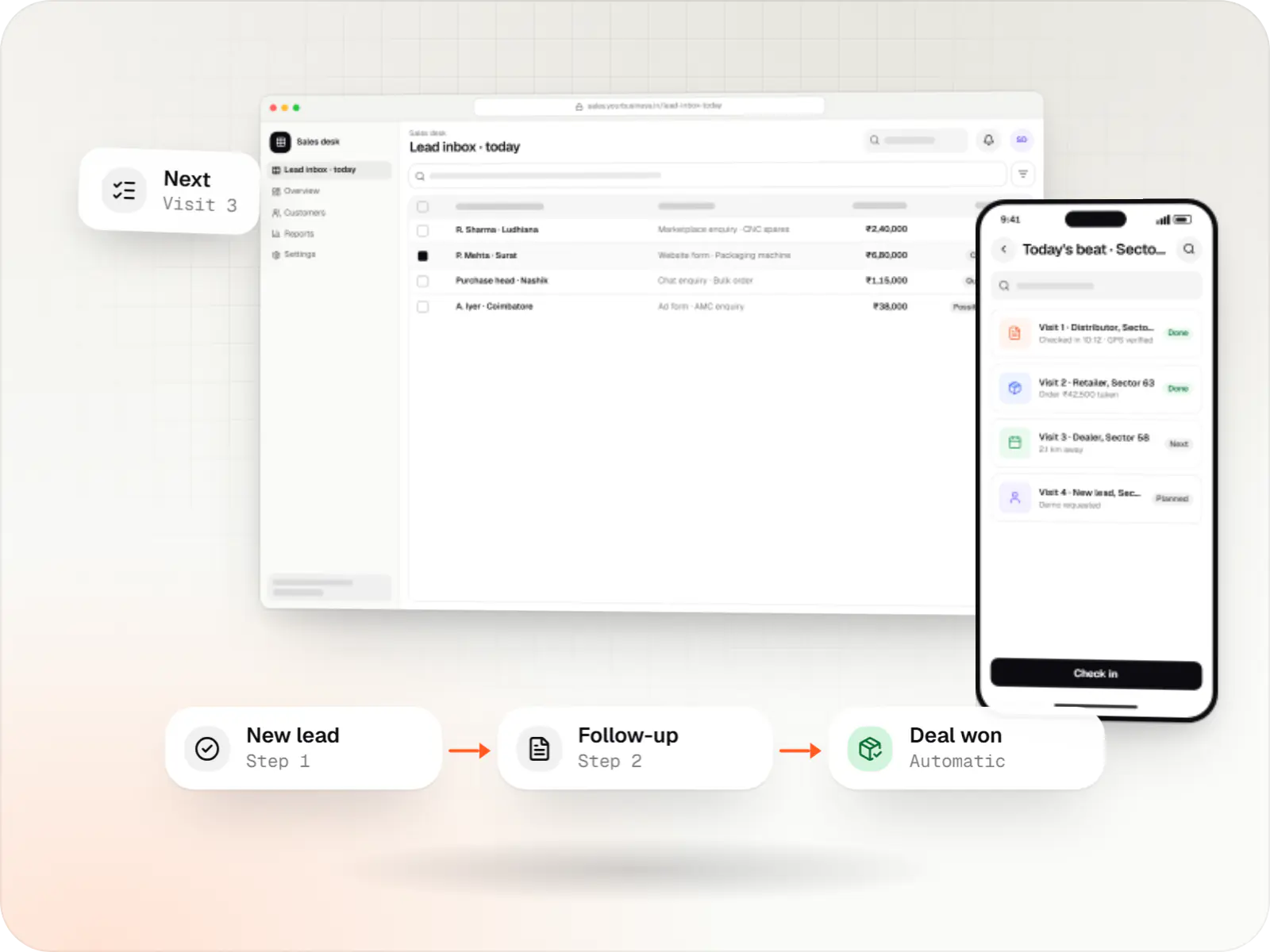
Custom CRM software that captures leads from every channel, keeps follow-ups on schedule and shows managers a live pipeline.
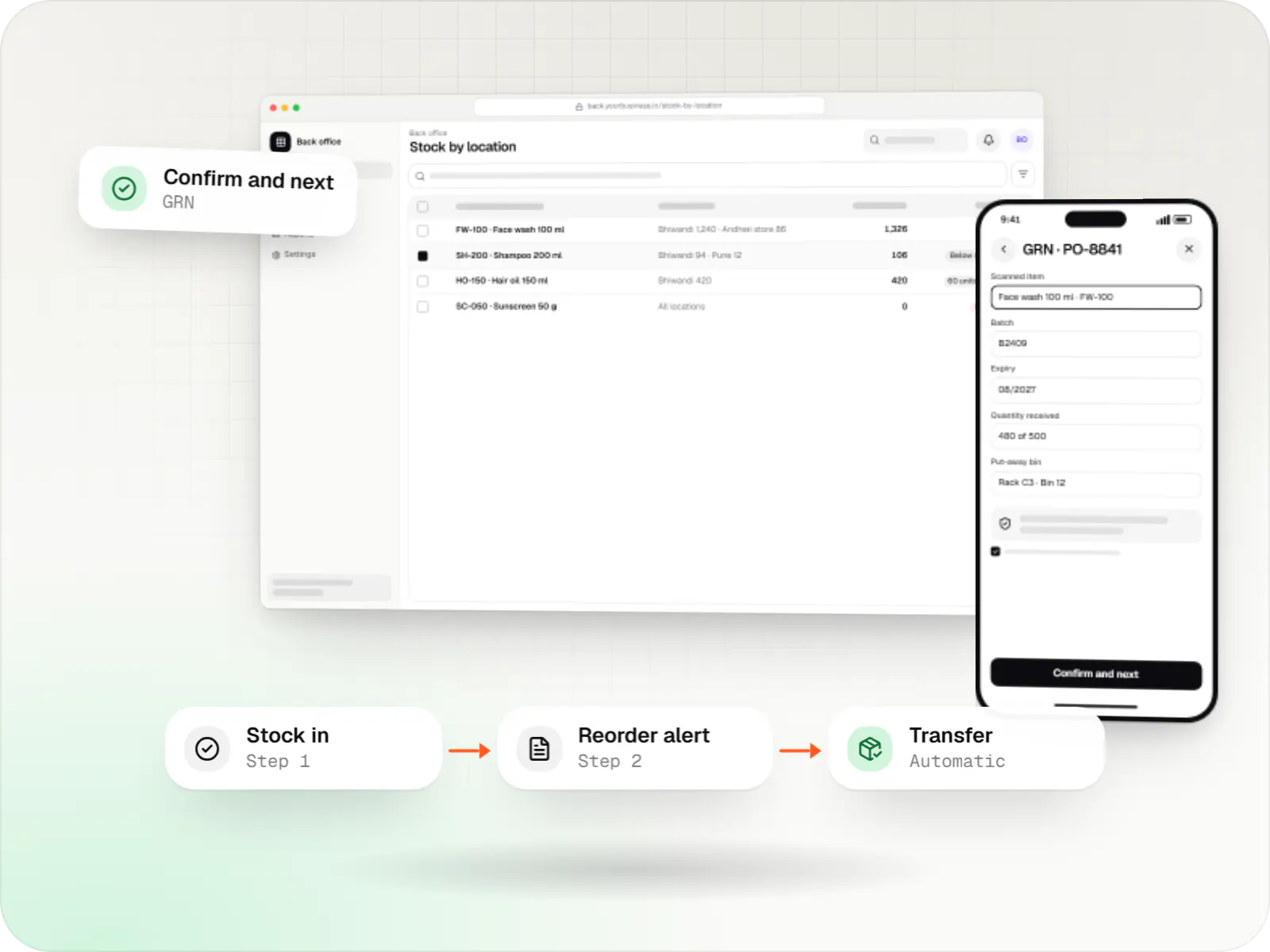
Custom inventory software for multi-location stock, batch and expiry tracking, barcode scanning and marketplace stock sync.
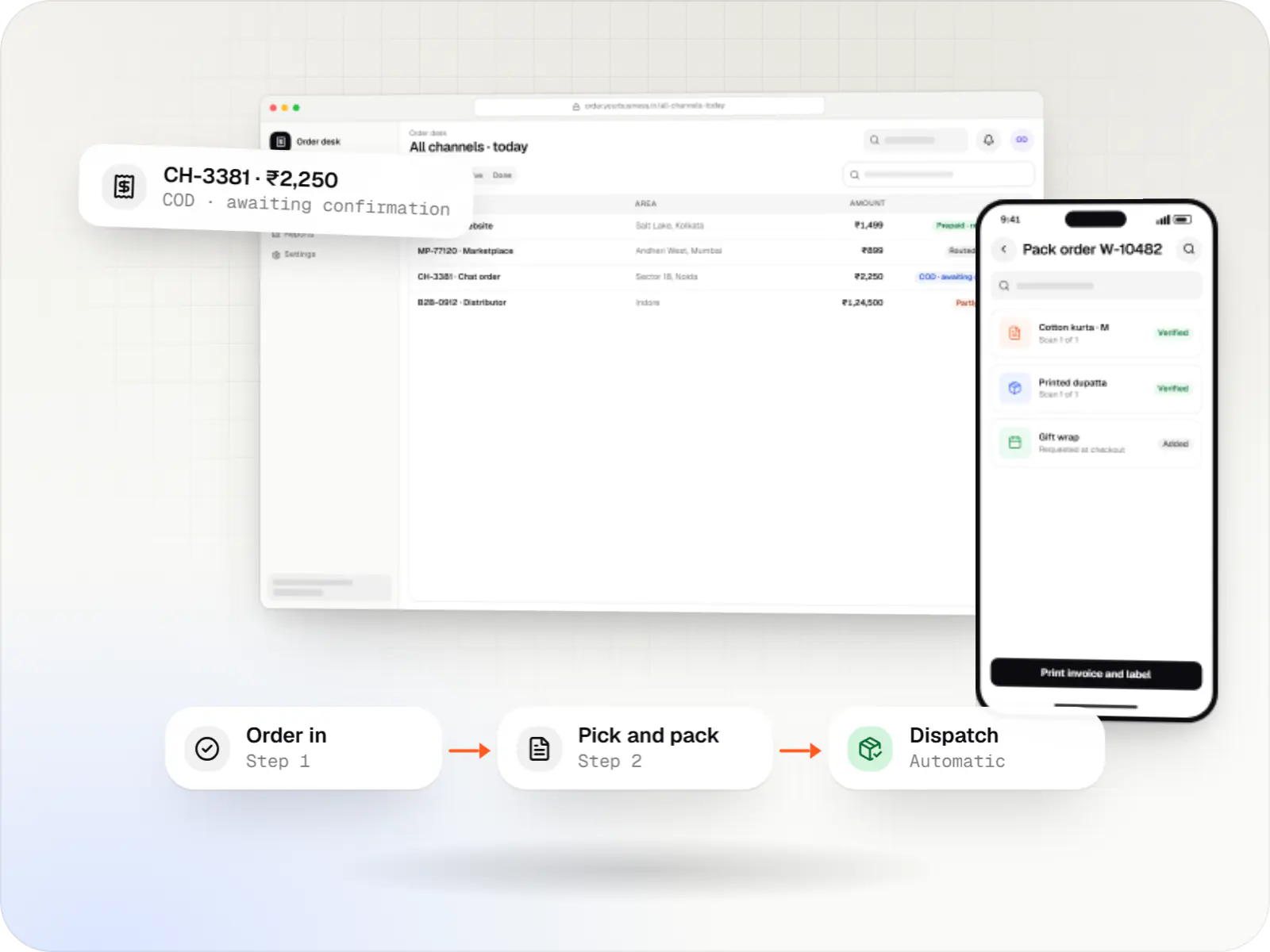
A central order management system that collects orders from every channel, routes them to the right location and tracks them to delivery and payment.
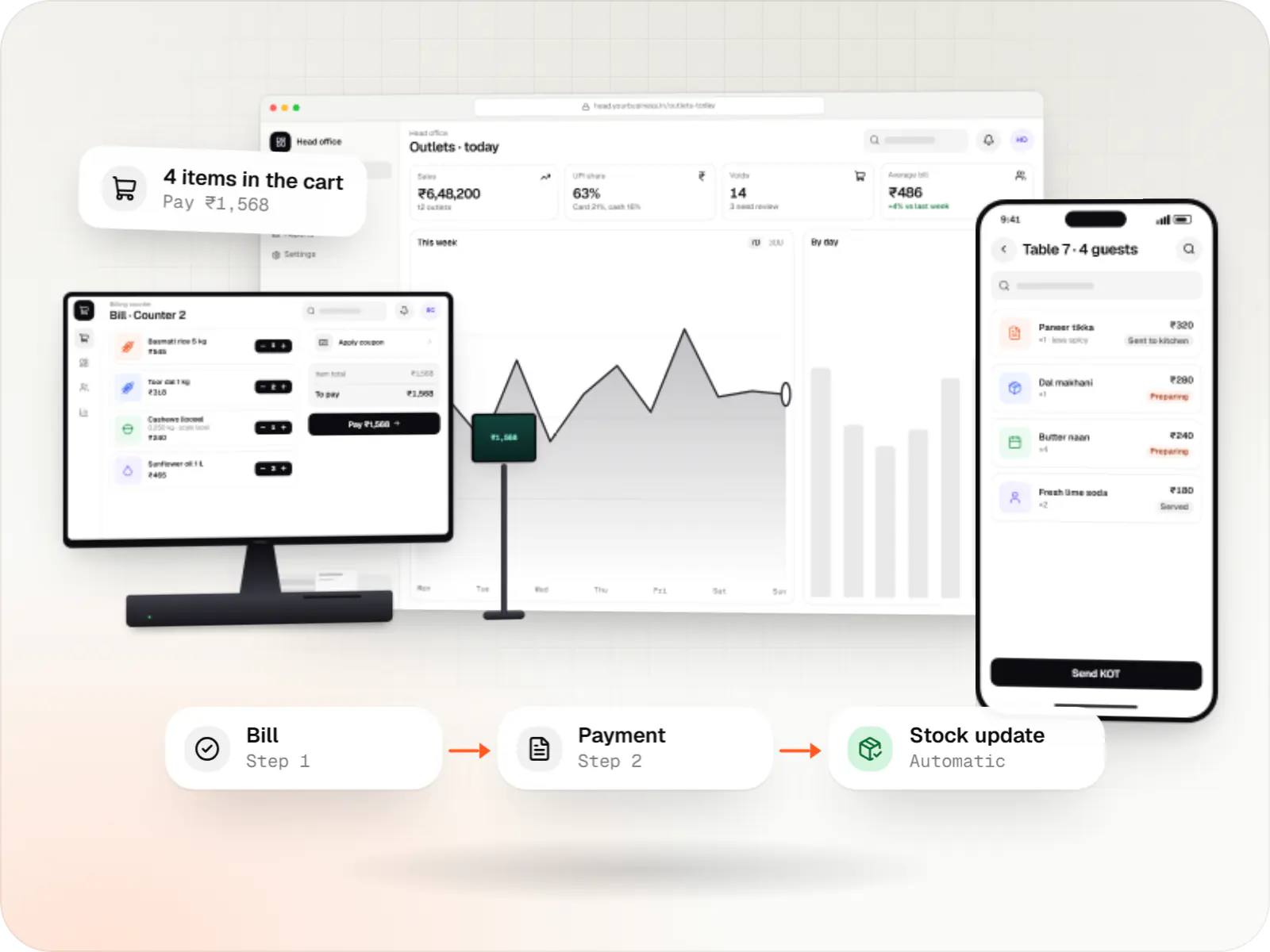
Custom point-of-sale software with offline billing, UPI QR payments, GST invoices, hardware integration and central control for multiple outlets.
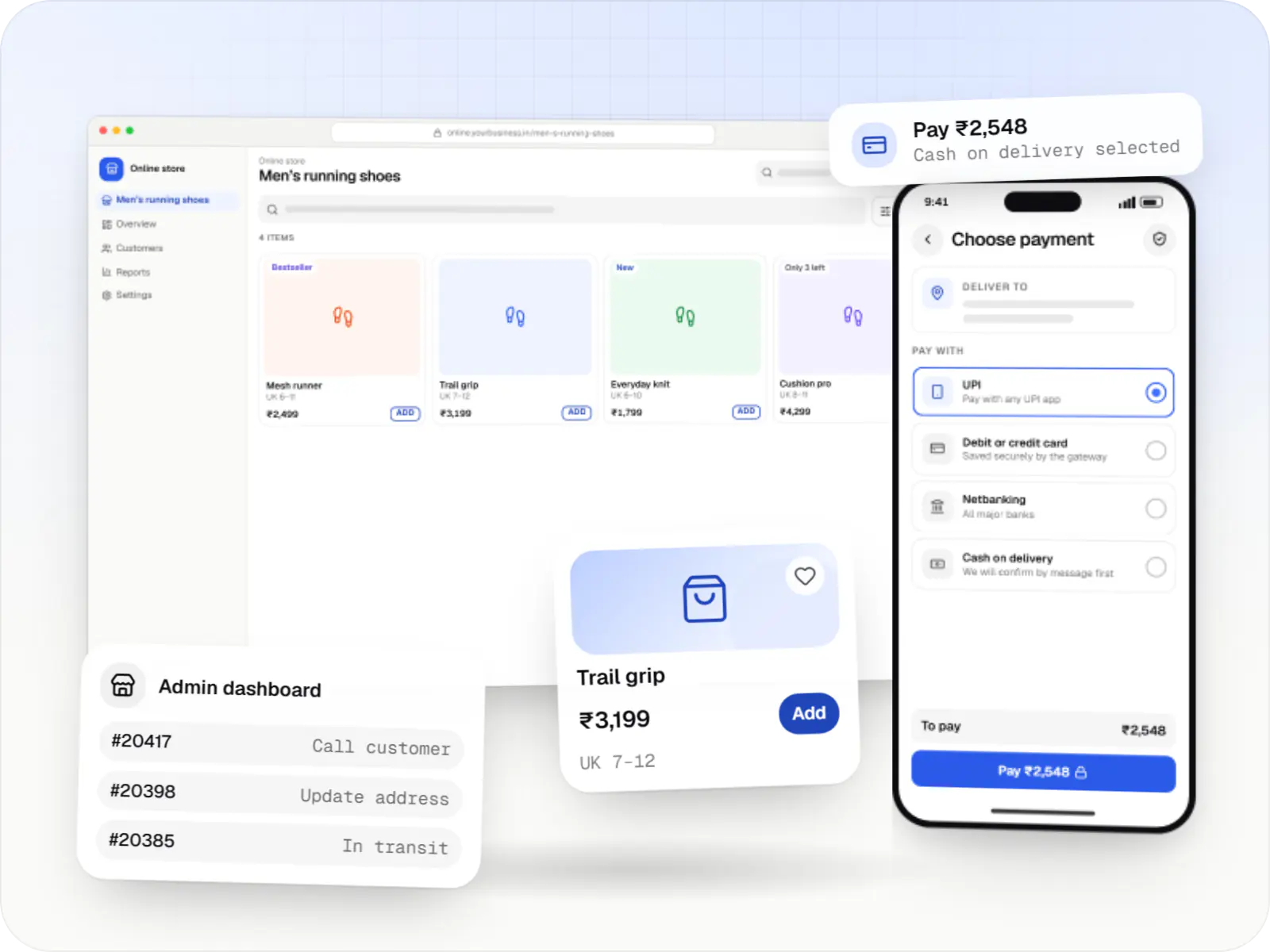
Fast, search-friendly online stores with UPI, card and COD checkout, GST invoices and courier integrations, on a hosted platform or custom code.
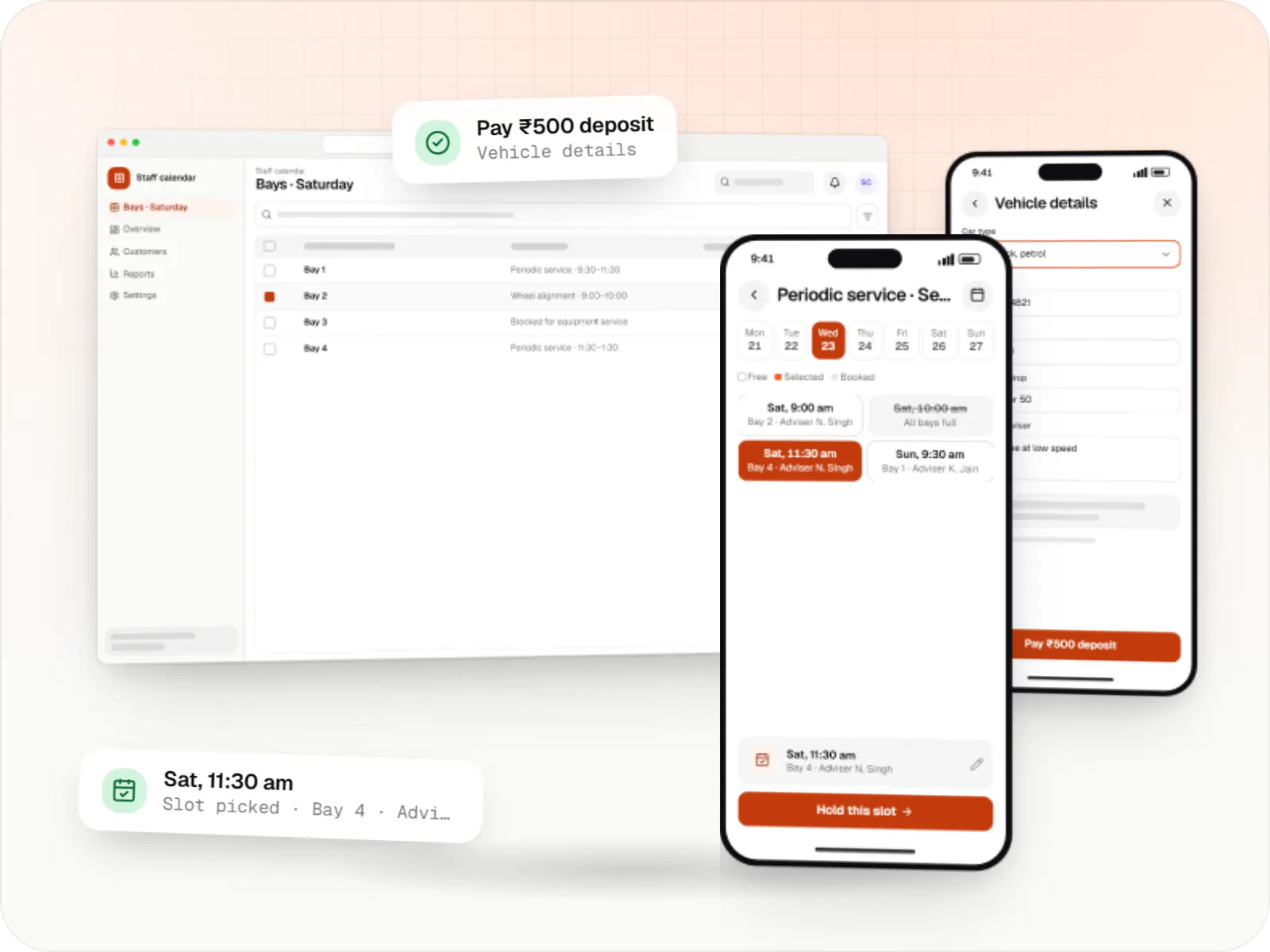
Custom scheduling software for consultants, service centres, labs and multi-location businesses: availability rules, reminders, payments and calendar sync.
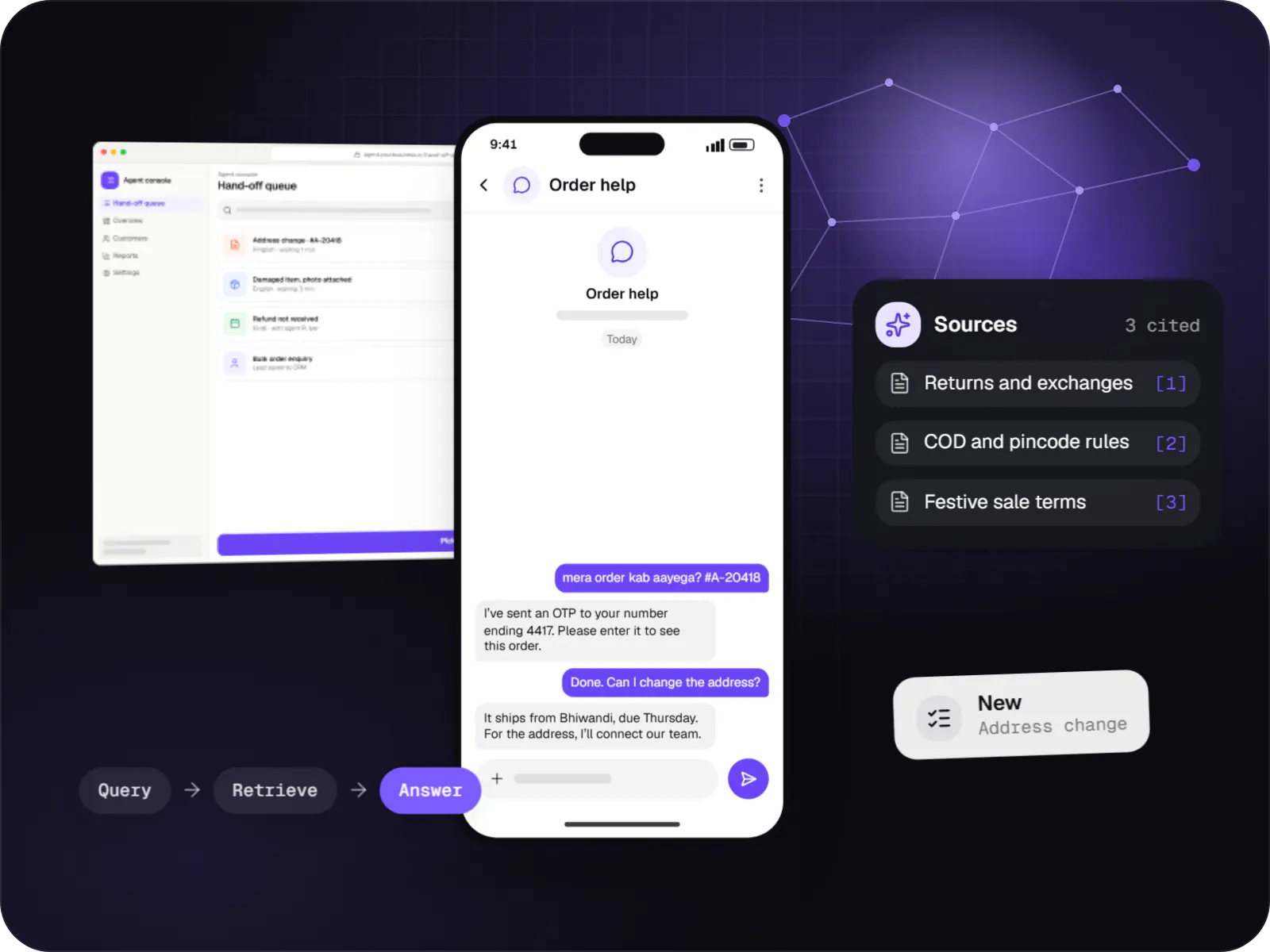
Support and sales chatbots for web, app and WhatsApp that answer from your own content and hand off to your team.
Invoices, receipts and stock movements pushed to your accounts instead of re-typed.
HSN/SAC codes and tax breakdowns, with e-invoicing added when your turnover requires it.
Catalogue sharing, order confirmations and payment reminders on the WhatsApp Business Platform.
Links and QR codes reconciled automatically against orders and invoices.
Staff see only what they need, so owners can delegate safely.
Daily sales, dues and low stock on one phone screen.
How it works
A typical trading or distribution business, where one order used to be typed into three different places.
A reorder link or a WhatsApp message becomes an order in the system, with items, quantities and that customer’s price list already attached.
Staff see live stock and the right rate, confirm in one tap, and the customer gets a confirmation on WhatsApp straight away.
The invoice is produced from the order itself, with HSN codes and the tax breakdown filled in, so nothing is typed a second time.
A UPI link or QR code travels with the invoice, and the payment is matched to it automatically when the money arrives.
Invoices, receipts and stock movements are pushed to Tally or Zoho Books, so your accountant keeps working in familiar software.
Sales, dues and low-stock items reach the owner’s phone each evening, and customers with overdue bills receive polite automatic reminders.
Platforms
Browser-based applications with logins, roles and workflows, such as customer portals, SaaS products and internal tools.
Installable web apps with offline support and notifications, useful when an app-store listing isn't essential or phones have little storage.
Apps for Android phones and tablets, tested on budget and mid-range devices and published on Google Play or privately.
Marketing and content websites: fast, search-friendly pages with a CMS your team can update without a developer.
Back-office panels for operations, support and finance teams: orders, users, content, reports and permissions.
Technology
Proven, affordable tools with modest hosting bills, and payment links your customers already know how to use.
Web
A modern web technology for fast, search-friendly websites, online stores and web applications that load quickly on mobile.
Used for
Backend
Runs the server side of apps: fast, scalable back ends that power your app, website and integrations.
Used for
Data
A reliable database for the records your business runs on: orders, payments, bookings and stock, kept accurate and easy to report on.
Used for
Cloud & DevOps
Ready-made building blocks for mobile apps, such as push notifications, phone OTP login and crash reports, so you launch sooner.
Used for
Mobile
Build Android and iOS apps from one shared codebase, so you launch on both platforms faster with a consistent experience.
Used for
Payments & maps
Lets customers in India pay by UPI, cards, netbanking or wallets, and handles subscriptions, refunds and payouts to sellers or partners.
Used for
Flutter and the related logo are trademarks of Google LLC. We are not endorsed by or affiliated with Google LLC.
Plain-English glossary
Product preview
Sample screens for a wholesale grocery distributor in Delhi; the figures are illustrative.
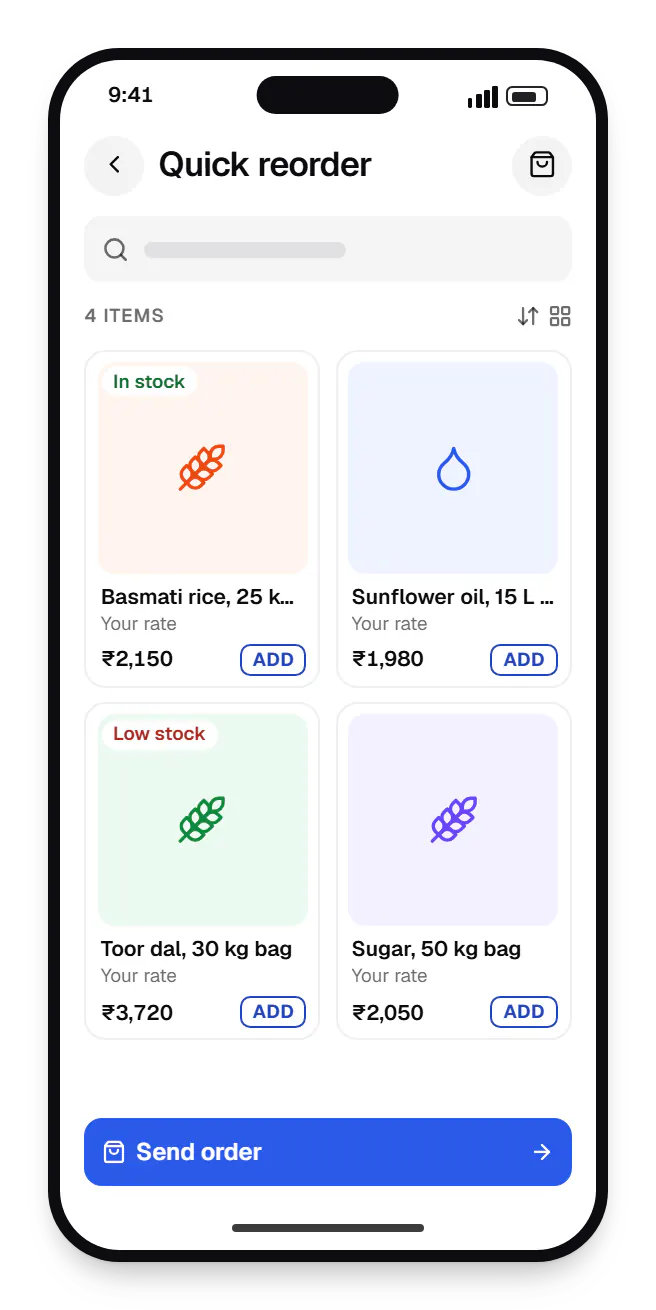
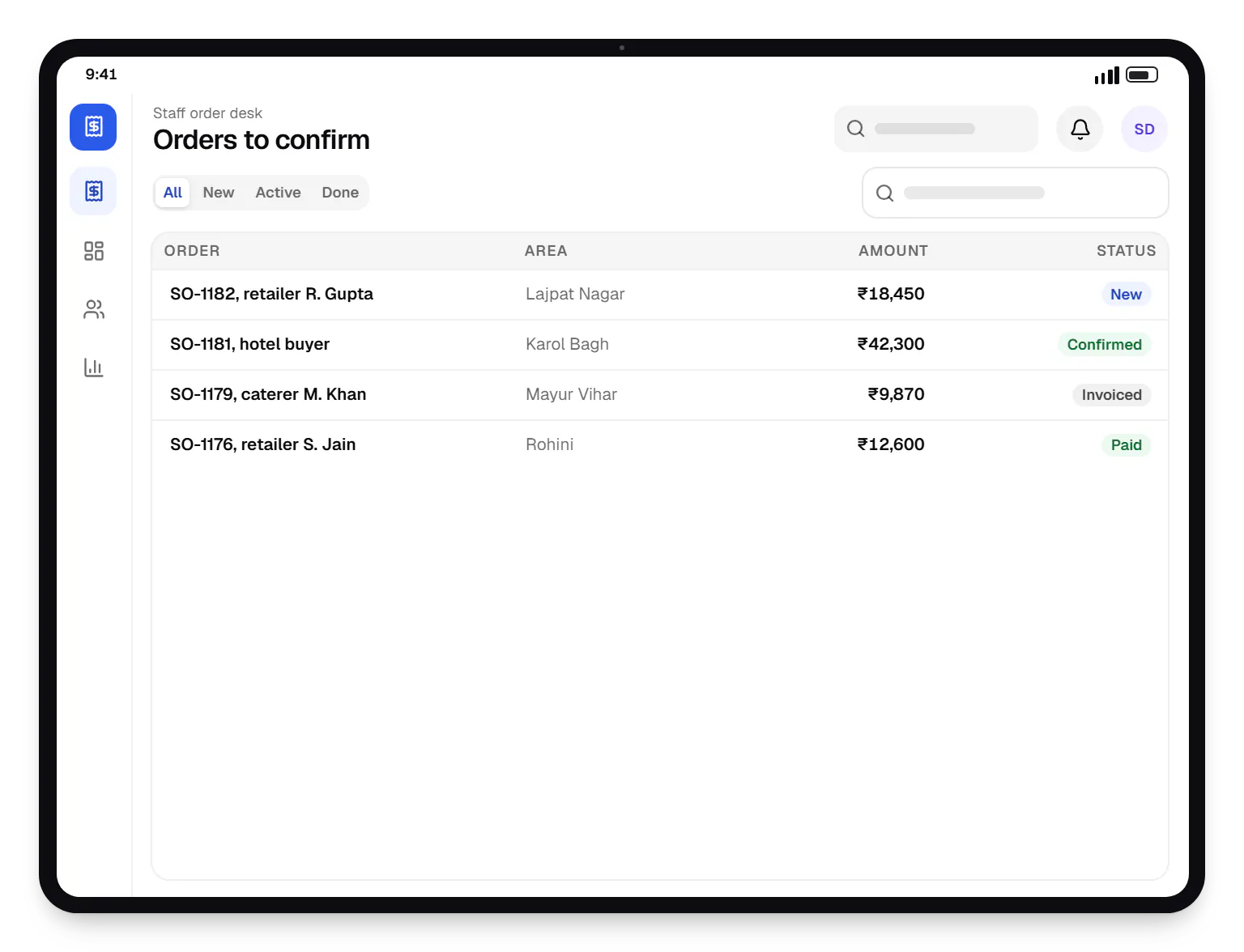
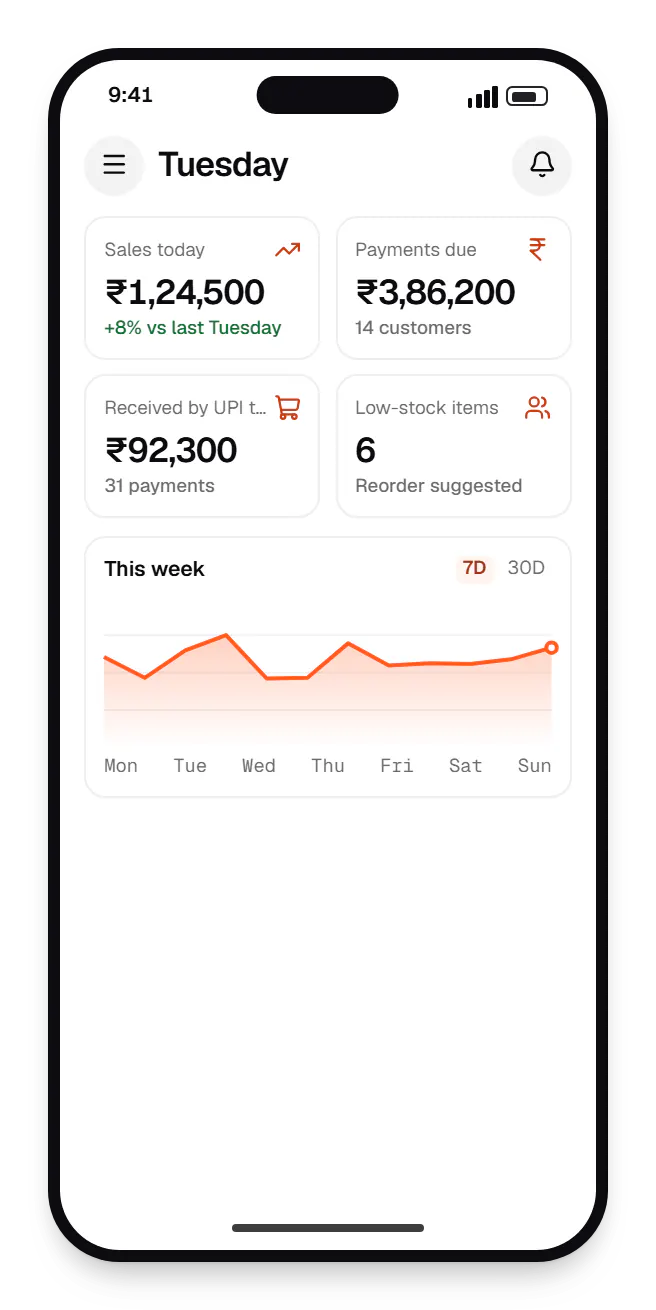
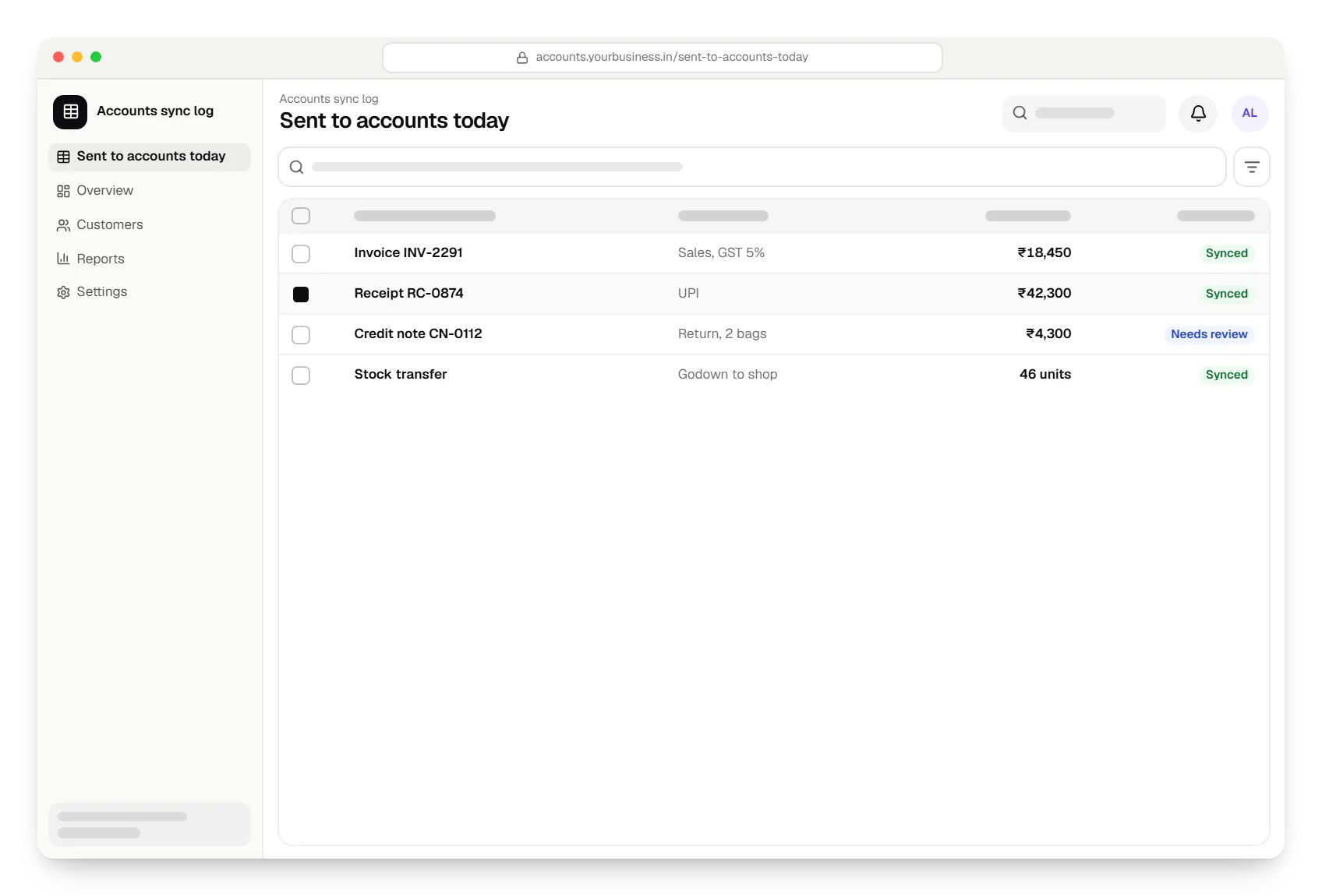
Sample screens: names, prices and figures are examples, not client data.
Comparison
| Off-the-shelf SaaS | Custom software | Hybrid | |
|---|---|---|---|
| Upfront cost | Low: monthly subscription | Higher: build cost first | Moderate: subscription plus a focused build |
| Time to start | Days to weeks | Weeks to months, in phases | Weeks for the custom part |
| Fit to your process | You adapt to the product | Built around how you work | Standard work in SaaS, unique steps custom |
| Integrations | What the vendor supports | Whatever your systems allow | A custom layer links SaaS to Tally or WhatsApp |
| Long-term cost | Per-user fees continue | Hosting and maintenance; you own the code | Both, at a smaller scale |
| Good fit for | Accounts, payroll, generic CRM | Ordering, pricing or operations that set you apart | Most growing SMBs |
Cost drivers
Starting with one workflow, such as orders or billing, keeps the first invoice small and the payoff visible.
Tally, e-invoicing, WhatsApp and gateways each add effort; we prioritise what removes the most manual work.
A web app or PWA avoids app-store overheads; native apps suit field staff who need offline use.
Right-sized hosting and a light support plan keep monthly costs predictable.
Estimates are written from your scope, with the effort and assumptions behind each line item.
How pricing worksServices
The design and engineering services our in-house team combines on projects in this sector.
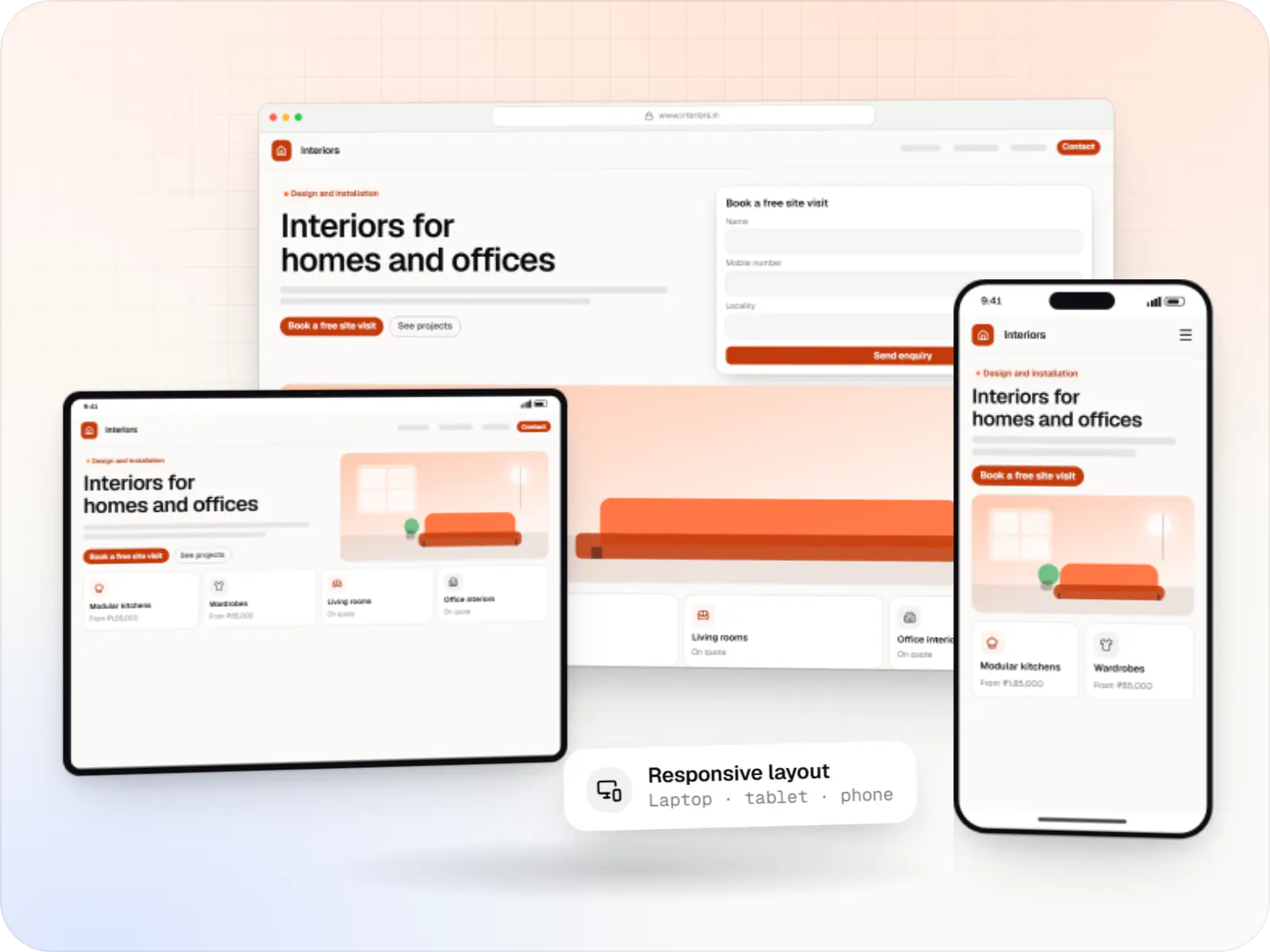
Fast, SEO-ready company and marketing websites with a CMS your team can edit, designed and built by our in-house team.
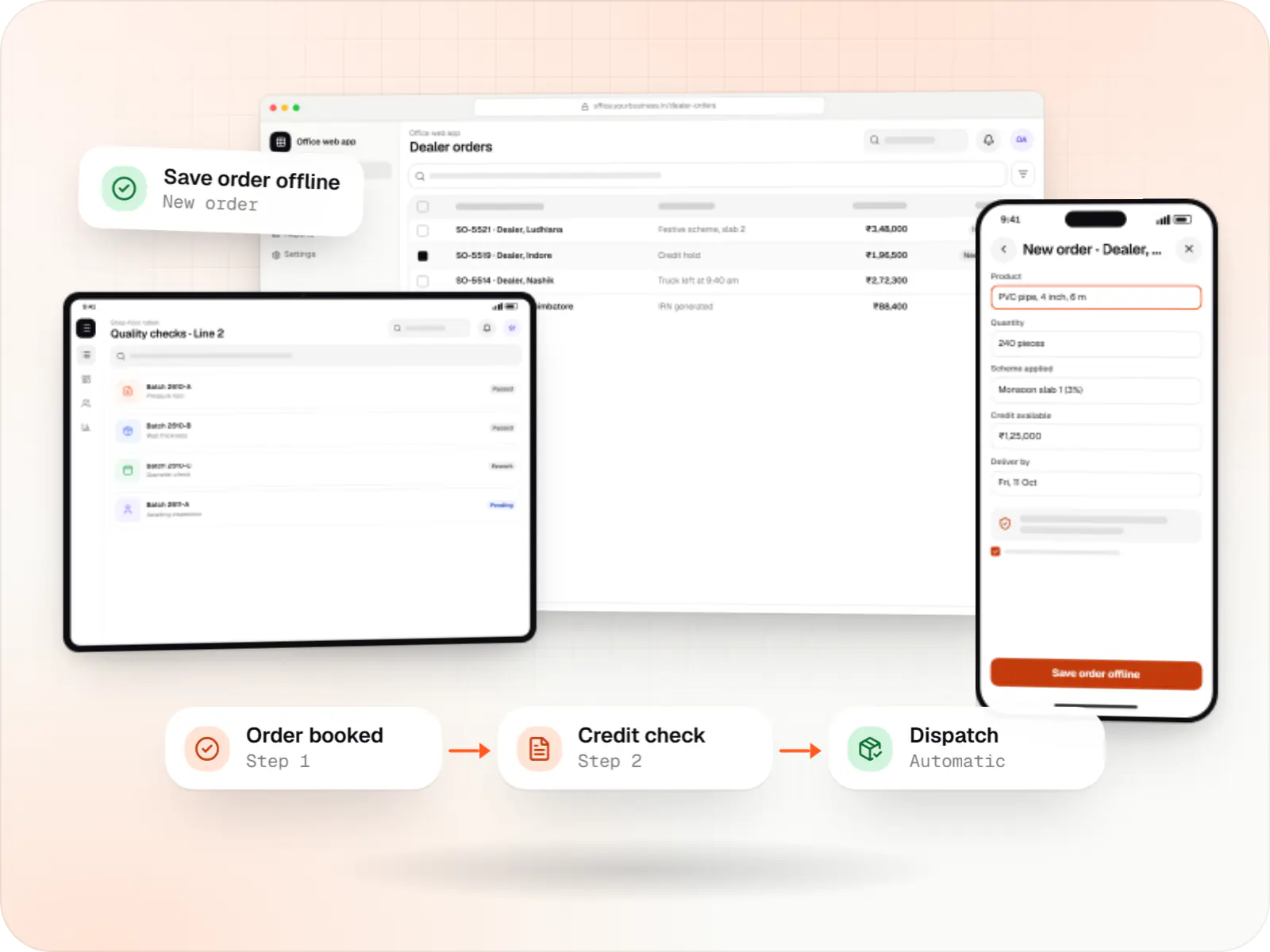
Software shaped around how your business runs, from approvals and inventory to billing and reports, replacing spreadsheets and disconnected tools.
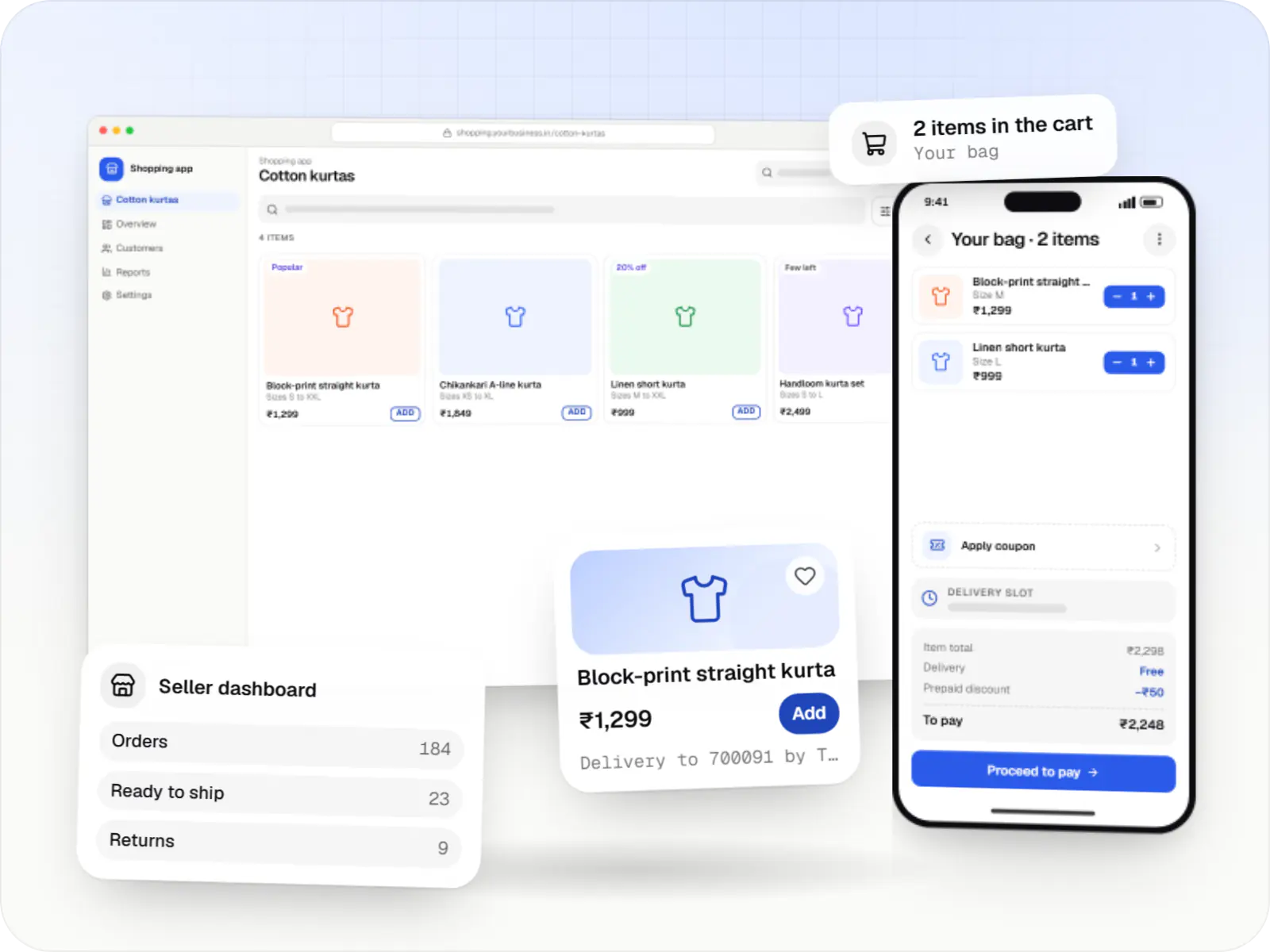
Online stores, shopping apps and B2B ordering portals on Shopify, WooCommerce or custom stacks, wired to Indian payments, couriers and GST invoicing.
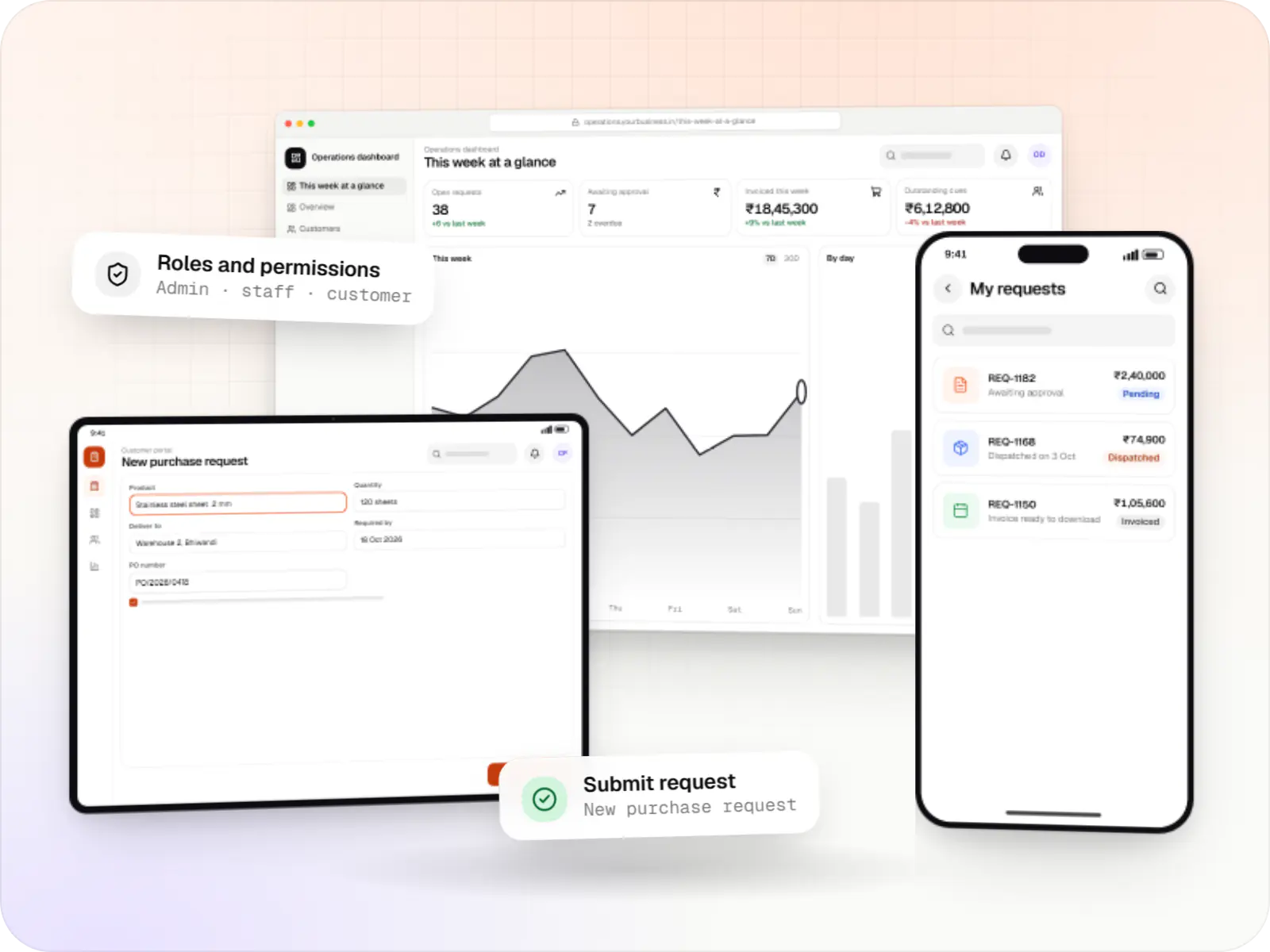
Browser-based products, customer portals, dashboards and internal tools, built on clean data models with secure roles and integrations.
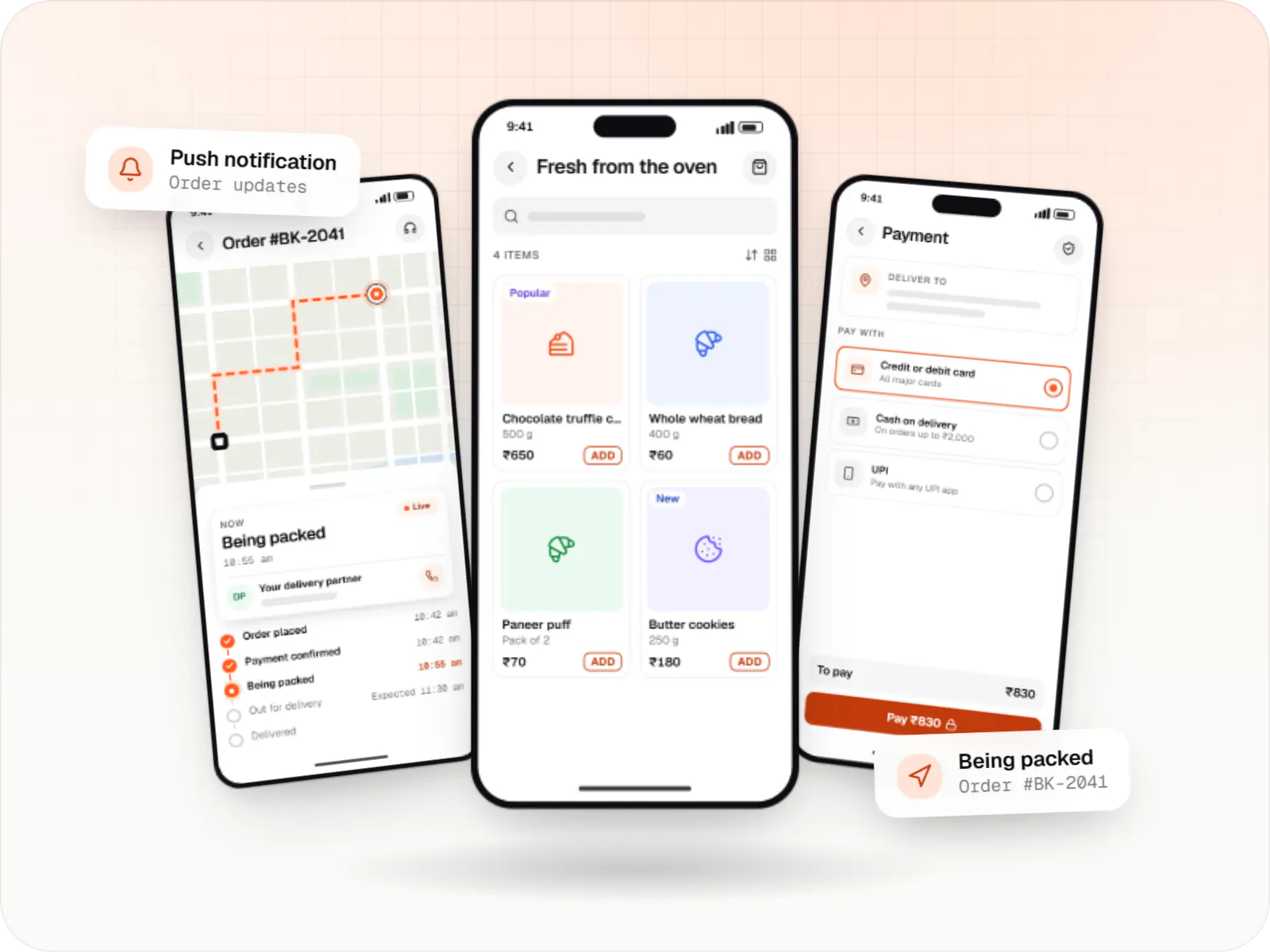
Native and cross-platform Android and iOS apps, from first release through regular store updates, built by our in-house designers and engineers.
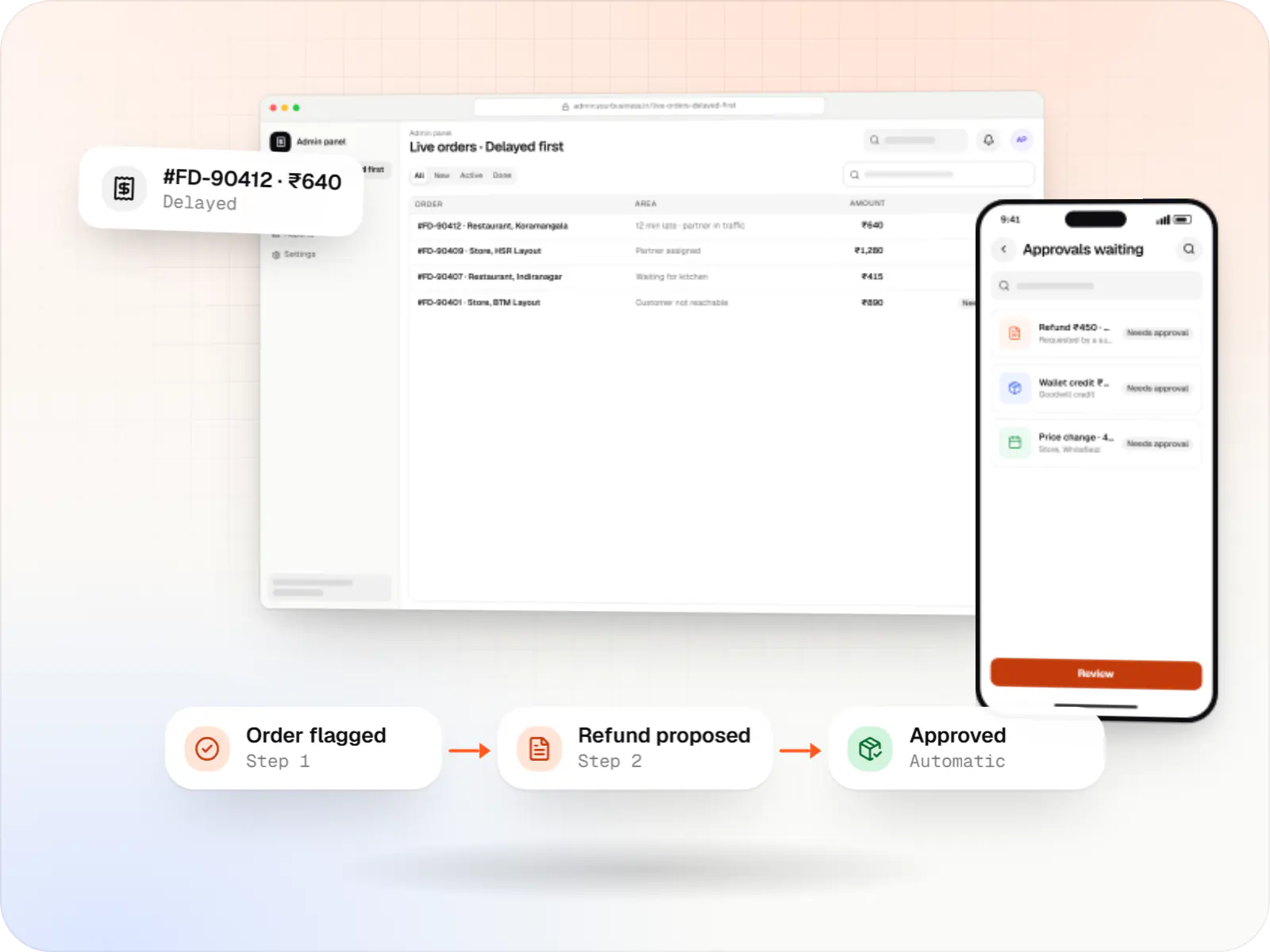
Back-office dashboards built around your team's daily tasks: order queues, approvals, catalogue management, payouts, reports and audit logs.
Locations
Cities where this sector is a significant part of the local economy. We work remotely with teams across India and meet in person where practical.

Uttar Pradesh
FAQ
Sometimes it isn't, and we'll say so. For accounting, payroll or basic invoicing, established products are usually cheaper and good enough. Custom software earns its cost when a process is specific to you, such as dealer ordering, job scheduling or multi-location stock, and the workaround costs staff hours or sales every week. If you can describe the workaround and roughly what it costs each month, a build is worth discussing.
Yes. TallyPrime can exchange data through XML over HTTP and through ODBC, and we use these to push sales invoices, receipts and stock movements from your custom system into Tally, so your accountant keeps working in familiar software. The design depends on whether Tally runs on one PC, a server or a remote-access setup, so we check that first.
Yes, and we recommend it. Phase one covers the workflow that hurts most, for example order capture and invoicing, and goes live on its own. Later phases add stock, a customer app or reports once the first part is in daily use. Each phase has its own estimate and you can pause between releases. The architecture is planned for the full picture, so later phases extend the system rather than redo it.
Only if your aggregate turnover is above the threshold notified for GST e-invoicing; below it, regular GST invoices are enough. The threshold has been lowered several times, so we build e-invoicing as an optional module that connects to the Invoice Registration Portal through a GST Suvidha Provider or direct API when you need it. Your CA should confirm whether it applies to you today.
Next step
Tell us what takes your team the most time today. We will give you an honest recommendation, even if it is an off-the-shelf tool.