Skip to content
Softcoderz

Pricing

Pricing and app development costs

How we price software projects: written line-item estimates, four engagement models and the factors that drive cost, explained before you commit.

  • Written, line-item estimates
  • 4 engagement models
  • 12 cost factors explained
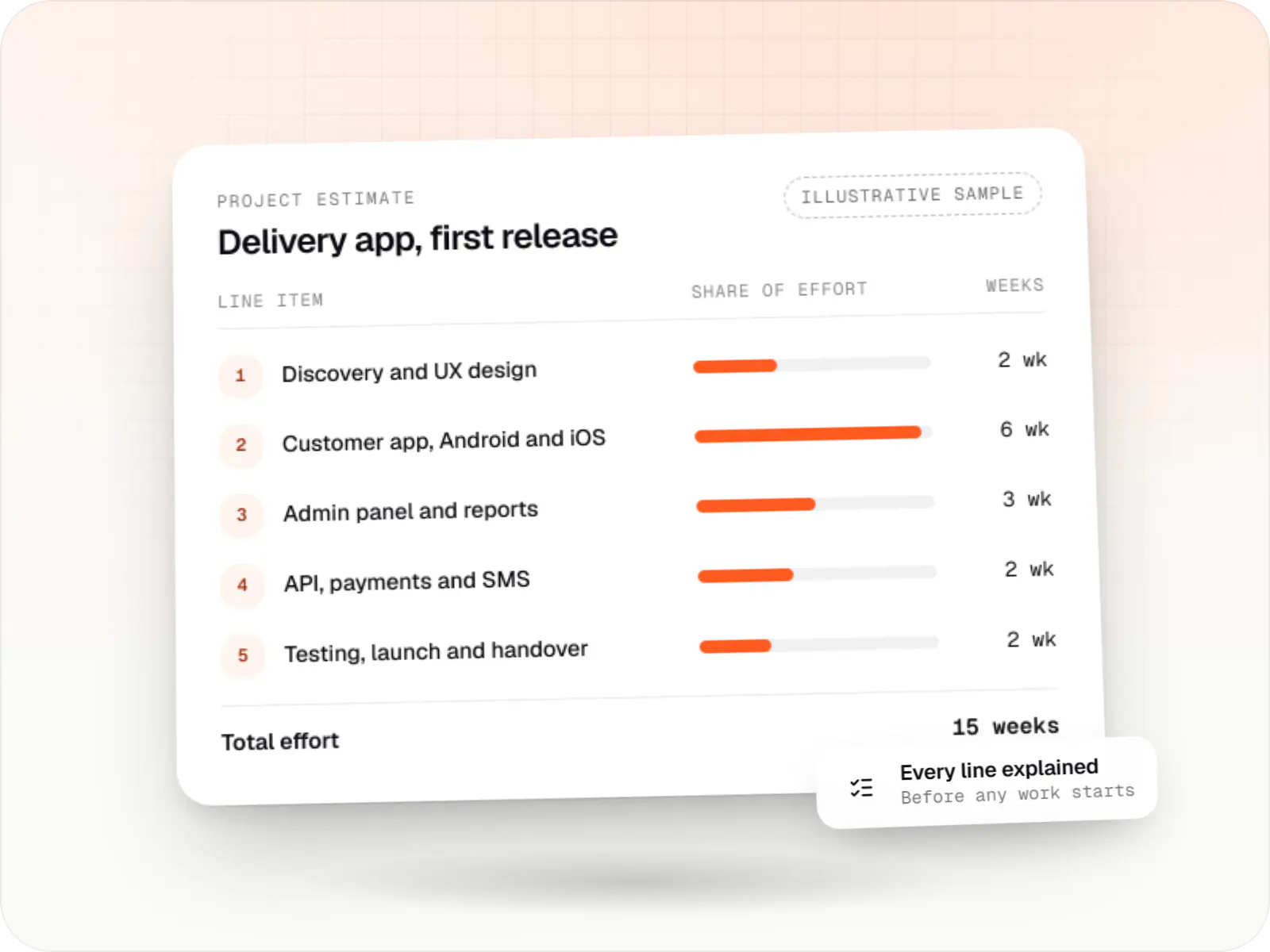
Sample project estimate sheet with line items for design, apps, admin panel, integrations and testing, and effort bars
Illustrative previewA line-item estimate: every part of the project with its share of the effort, before any work starts.

How we think about pricing

We do not publish package prices, because two apps with the same name can differ enormously in effort. A grocery app for one store with cash on delivery is a very different build from a multi-city platform with slots, substitutions and partner payouts.

Instead, every project gets a written estimate built from its actual scope. You see the effort behind each feature, the assumptions behind each number and what we suggest leaving until after launch. Our aim is competitive Indian-market pricing for engineering you would be comfortable handing to another team later.

Engagement models

Choose how you want to work

4 ways to work with us. Every estimate names the model we suggest for your scope, and why.

  • Fixed-scope project

    Suggested starting point

    A defined scope, timeline and set of deliverables agreed upfront, paid in milestones as each one is delivered and reviewed.

    Best for
    MVPs, websites and apps with a clearly defined scope
    How billing works
    Milestone-based payments, each tied to agreed deliverables
    • Scope, timeline and deliverables agreed upfront
    • Pay as each milestone is delivered and reviewed
    • Change requests estimated before any work starts
    • Source code and documentation handed over at launch
  • Dedicated team

    Developers, a designer and QA working on your product month to month, sized to your roadmap and adjusted as it changes.

    Best for
    Ongoing product development and evolving roadmaps
    How billing works
    A monthly fee for a team sized to your roadmap
    • Developers, designer and QA on your product
    • Scale the team up or down month to month
    • Weekly demos and a shared task board
    • Your backlog, priorities and release schedule
  • Hourly & flexible

    Pay for the hours worked on small changes, audits and support, within a monthly or per-task cap you approve in advance.

    Best for
    Small changes, audits and ongoing support
    How billing works
    Billed on hours logged, within a cap you approve
    • Bug fixes, small features and updates
    • Code, performance and security audits
    • Timesheets shared with every invoice
  • Enterprise & custom

    Contracts shaped around larger programmes: complex integrations, compliance requirements, several workstreams and service levels agreed in writing.

    Best for
    Complex integrations, compliance needs and larger rollouts
    How billing works
    Custom contracts with SLAs agreed in writing
    • Defined SLAs for response and uptime
    • Security reviews and full documentation
    • Integrations with ERP, CRM and legacy systems
    • Named contacts and a regular governance review on both sides

Cost factors

What drives the cost

Each of these shows up as a line in your estimate, so you can see what to build now and what can wait.

  1. Project scope

    The number of screens, features and user roles. Each role, such as customer, store staff or admin, adds its own flows to design, build and test.

  2. Number of platforms

    Web, Android, iOS or all three. Cross-platform frameworks reduce duplicate work, but each platform still needs its own testing and store release.

  3. Design complexity

    A clean interface on an established UI kit takes less effort than a custom design system with bespoke illustrations and motion.

  4. Integrations

    Connections to ERP, CRM, accounting, logistics or internal systems. Effort depends on the quality of their APIs and documentation.

  5. AI model & API usage

    Whether a feature calls a hosted model, retrieves from your documents (RAG) or needs custom training, plus ongoing usage costs at your expected volumes.

  6. E-commerce features

    Catalogue size and variants, offers and coupons, GST invoicing, returns and multi-vendor rules each add to the build.

  7. Delivery workflows

    Delivery slots, serviceable zones, delivery partner dispatch, live tracking and cash-on-delivery reconciliation.

  8. Admin dashboards

    Role-based access, operational tools, reports and exports for the people who run the business every day.

  9. Third-party services

    Payment gateways, maps, SMS, WhatsApp and email providers. Setup is part of the build; usage fees are billed by the providers.

  10. Security requirements

    Encryption, audit logs, access control, penetration testing and compliance needs such as data protection or sector rules.

  11. Maintenance & support

    Monitoring, OS and dependency updates, bug fixes and response times after launch, agreed as a support plan or a monthly team.

  12. Timeline

    A standard schedule or a compressed one. Faster delivery needs more people working in parallel, which adds coordination effort.

What every estimate includes

  • Line items by feature

    Each module, such as checkout, delivery slots or the admin dashboard, is listed with its own effort range.

  • Effort by role

    Design, web, mobile, backend and QA effort shown separately, so trade-offs are visible.

  • Written assumptions

    What we assumed about integrations, content, devices and volumes, so surprises surface early.

  • Exclusions and third-party costs

    App store fees, hosting, messaging and AI API usage, listed separately.

  • Milestones

    Phases with deliverables you review and approve, linked to payments for fixed-scope work.

  • A suggested first release

    What to build first, and what can wait for real usage data.

Process

How a sample estimate comes together

Using a grocery delivery MVP for Android and iOS as the example:

  1. Break the product into modules

    Discovery and UX, the customer app, the store and admin panel, payments and notifications, and QA and launch each become a line item.

    You getModule list

  2. Estimate effort per module

    Each line gets an effort range by role: design, Flutter, backend and device testing.

    You getEffort ranges by role

  3. Find what can run in parallel

    The admin panel is built alongside the customer app, so the calendar timeline is shorter than the total effort.

    You getTimeline and milestones

  4. Write down the assumptions

    For example: UPI first with COD as a fallback, and one city at launch.

    You getAssumptions list

  5. Review it together

    We move features between the first release and later phases until the scope fits your budget and date.

    You getAgreed scope

Comparison

Choosing an engagement model

Choosing an engagement model
Fixed-scopeDedicated teamHourlyEnterprise
ScopeAgreed upfrontEvolves with your roadmapTask by taskAgreed per workstream
BillingMilestone paymentsMonthly feeHours logged within a capCustom contract
Handling changesEstimated as change requestsReprioritised in the backlogAdded as new tasksFormal change control
SuitsMVPs and defined buildsProducts after launchFixes, audits and small featuresIntegrations, compliance and larger rollouts

FAQ

Frequently asked questions

Why don't you publish fixed package prices?

Because packages hide the decisions that drive cost. Two e-commerce apps can share a name but differ in catalogue size, payment options, delivery logic, integrations and admin needs. A package either overcharges the simple one or underprices the complex one and recovers the difference through change requests. A line-item estimate shows exactly what you are paying for.

Can you work to a fixed budget?

Often, yes. Tell us the budget along with the scope, and we will show which features fit in a first release and which could move to a later phase. Fixing the budget usually means being flexible on scope, so we agree priorities upfront. If the budget is too tight for a product that would work reliably, we will say so rather than cut corners on testing or security.

What costs sit outside the development estimate?

Third-party and running costs are listed separately so you can plan for them. Typical items include Apple and Google developer account fees, domain and cloud hosting, SMS and WhatsApp message charges, email delivery, map API usage, payment gateway fees, AI model API usage and any paid software licences. Most are billed by the providers directly to your own accounts, so they stay under your control.

How are scope changes handled once work has started?

On fixed-scope projects, a change request is estimated before any work starts: you see the added effort and any timeline impact, then decide whether to go ahead, swap it for something else or park it for a later phase. With a dedicated team, changes are reprioritised in the backlog. Either way, nothing is added to your invoice without written approval.

How are payments structured?

Fixed-scope work is paid in milestones, each tied to deliverables you review, such as an approved prototype or a feature-complete test build. Dedicated teams are billed monthly, and hourly work is invoiced against logged time with timesheets attached. Enterprise contracts follow the payment terms agreed in writing. Invoices include GST where applicable.

Next step

Get an estimate for your project

Share a rough scope and we will send back a line-item estimate with assumptions, usually after a short call.

Or reach us directly

Mon–Sat, 10:00–19:00 IST